


Table of Contents
- Why Anime Print Clothing Needs Different Care
- How to Wash Graphic Tees Without Cracking
- Drying Anime Print Clothing Without Heat Damage
- How to Fix Peeling Print on Shirt
- How to Store Anime Clothing for Long-Term Preservation
- Stain Removal and Material-Specific Care
- Eco-Friendly Laundry Alternatives That Protect Prints
- Conclusion
- Frequently Asked Questions
Last Updated: September 13, 2026
Why Anime Print Clothing Needs Different Care
Anime print clothing is apparel decorated with anime artwork applied through heat transfer, screen print, or direct-to-garment methods, and those print methods behave very differently from dye that soaks into fabric. That difference is the whole reason a standard wash cycle can ruin a favorite tee. At YKTV STORE, we understand the importance of proper care for printed apparel. Many customers treat a printed shirt like a plain one and watch the design crack within a few months.

Most care guides treat every graphic tee the same. They shouldn't. The print sits on top of the fabric rather than inside it, which means friction, heat, and harsh chemicals attack the design directly. A common mistake is assuming a print is durable because the fabric feels thick.
The good news is that print longevity comes down to a handful of habits, not expensive products. Below, we'll walk through washing, drying, repairing, storing, and stain removal so your anime print clothing stays sharp for years.
How to Wash Graphic Tees Without Cracking
The single most effective way to wash graphic tees without cracking is to turn them inside out, use cold water on a delicate cycle, and skip the dryer entirely. Those three habits prevent most of the damage that leads to cracked and peeling prints.
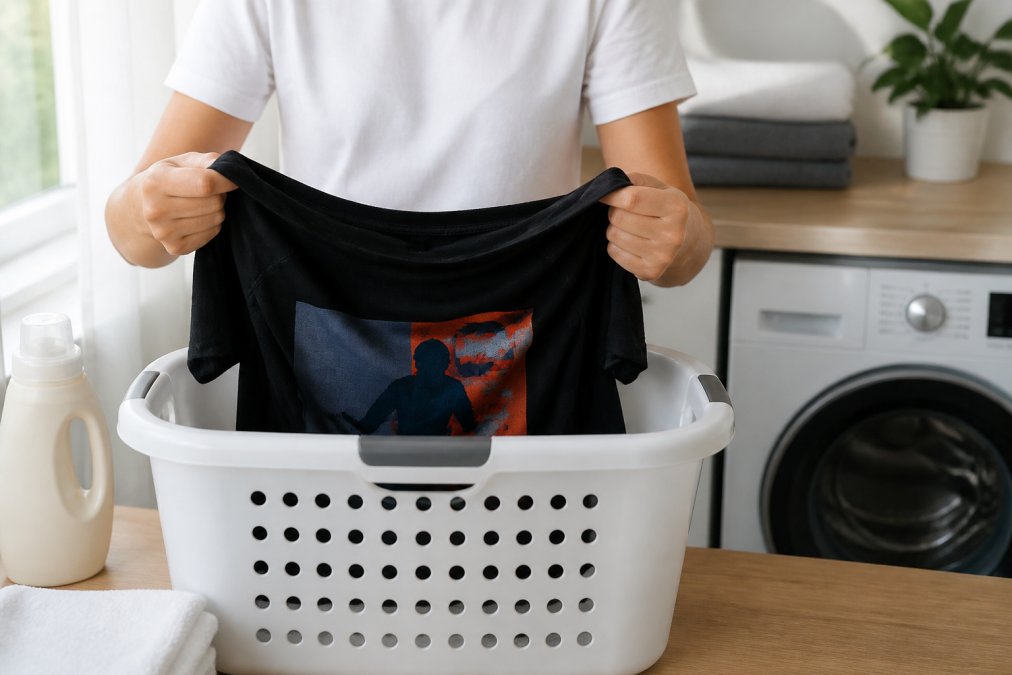
Friction is the quiet killer here. When a print rubs against other garments, zippers, or the drum itself, the ink layer gradually lifts at the edges. Inside out, the fabric takes the abrasion instead of the artwork.
Washing Temperature and Detergent Rules
Cold water wash is non-negotiable. Heat softens the ink layer and weakens its bond to the fabric, and that damage is cumulative, so a shirt that survives one hot wash may still fail after five.
Use a mild detergent without bleach or fabric softener. Bleach damage shows up as faded, blotchy color, and fabric softener leaves a residue that interferes with how well the print adheres. For cotton and cotton blends, a gentle liquid detergent is enough.
- Water temperature: cold only
- Detergent: mild, bleach-free, no fabric softener
- Load size: small, with similar colors
- Zippers and hooks: fastened or turned away
Inside Out, Delicate Cycle, and Spin Speed
Set the machine to a delicate cycle and drop the spin speed to its lowest setting. High spin speeds create the centrifugal friction that pulls at print edges, especially on heat transfer designs.
If your machine has a hand-wash or gentle option, use it. For a shirt you really care about, hand washing in cold water with mild detergent is the safest route, and it takes about five minutes.
Drying Anime Print Clothing Without Heat Damage
Air dry is the answer for anything with a print. Heat from a tumble dry cycle is the fastest way to shrink, crack, and peel a design, and the damage usually shows up after the shirt is already dry (cleaninginstitute.org).
Hang the shirt inside out on a plastic hanger or lay it flat on a drying rack. Avoid direct sunlight for extended periods, since UV exposure fades print colors over time, particularly on darker garments (peer-reviewed research). A shaded indoor rack works best.
If you must use a machine, choose the lowest heat setting and remove the shirt while it's still slightly damp. Never tumble dry on high.
How to Fix Peeling Print on Shirt
You can fix a peeling print on a shirt at home if the damage is caught early. Small lifted edges respond well to heat and pressure, while large missing sections generally can't be restored.
Here's the repair process:
- Turn the shirt inside out and lay it flat on an ironing board.
- Place a piece of parchment paper over the affected area on the printed side.
- Set the iron to low heat with the steam setting off.
- Press firmly for 10 to 15 seconds, then let it cool completely before moving the shirt.
- Repeat once if the edge still lifts.
Ironing and Steam Techniques for Printed Designs
Never place an iron directly on a print. Direct contact melts the ink and leaves a shiny, stuck patch that can't be fixed. Always use a pressing cloth or parchment paper between the iron and the design.
Steam is useful for wrinkles in the fabric, but keep the steam setting off when you're near the print itself. If your iron has a vertical steam option, hold the shirt up and steam the fabric around the design rather than across it.
For stubborn wrinkles, iron the shirt inside out from the back. The print stays protected while the fabric smooths out.
How to Store Anime Clothing for Long-Term Preservation
If you wear your anime print clothing weekly, storage barely matters. If you are holding a limited-edition drop, a signed piece, or a print you plan to keep for a decade, storage is the difference between a shirt that still looks new and one with a yellowed collar and a cracked design. This is the part most care guides skip, and it is the part collectors actually need.
Why Prints Degrade in Storage
Three things attack a stored print: light, moisture, and acid. UV light fades print colors even in a dark room if the piece sits near a window. Trapped moisture encourages mildew and can break down the ink layer. And acid, from cardboard boxes, wood shelves, and some plastics, migrates into fabric over time and causes the yellowing you see on older white tees (si.edu).
Storage Setup for Collectors
- Fold, don't hang. Hanging stretches shoulders and can distort a print over years. Fold along the sides, not across the design, so the print itself never becomes a crease line.
- Use acid-free tissue or a cotton pillowcase between folds and around the print. This buffers the fabric from acid migration and from its own folds.
- Skip cardboard and wood. Both are acidic. A clean, dry drawer or a shelf lined with acid-free paper is safer than a cardboard box or a wooden chest.
- Avoid sealed plastic bags for long-term storage. Trapped moisture is worse than dust. If you want a barrier, use a breathable cotton bag or a garment bag labeled "breathable", not a vacuum-sealed bag.
- Control humidity. A cool, dry space away from windows, bathrooms, and basements is ideal. Damp air is the leading cause of mildew on stored fabric.
- Keep light off the piece. A dark drawer or a closed closet beats a display shelf if preservation is the goal. If you must display, keep it out of direct sun and rotate it off the wall periodically.
Rotation and Wear Habits
Even collectors wear their favorites. Rotating what you wear spreads friction across more pieces, so no single print takes all the abrasion. When a piece comes out of storage, air it briefly before wearing, and put it back clean, body oils and deodorant residue set into fabric over time and are much harder to remove after months in a drawer.
Labeling and Inventory
If you store more than a handful of pieces, label each bag with the design name and the date it went in. A simple note saves you from unfolding everything to find one shirt, and it lets you track which pieces have been stored longest so you can inspect them for yellowing or print lift once a year.
Stain Removal and Material-Specific Care
Most care guides give one set of rules for every graphic tee. That is the fastest way to ruin a print, because the base fabric decides how much heat the design can survive. A heat-transfer print on a 100% cotton tee and the same print on a polyester performance shirt behave nothing alike in the wash, under an iron, or in storage.
How Base Fabric Changes Print Care
100% cotton. Cotton is the most forgiving base for prints. It tolerates cold water, mild detergent, and low-heat pressing better than synthetics, and it does not hold onto oils the way polyester does. The trade-off is shrinkage: cotton can shrink in a hot wash or dryer, and that shrinkage pulls at the print and causes cracking even when the ink itself was never overheated. Keep cotton cold and air-dried and the print stays flat.
Polyester and synthetic blends. Polyester is heat-sensitive at temperatures cotton shrugs off. A heat-transfer print on polyester can soften, gloss, or lift at iron settings that would be perfectly safe on cotton, so treat any synthetic base as low-heat only. Polyester also holds oil-based stains, cooking oil, lotion, sunscreen, far more stubbornly than cotton, and it can develop a permanent gray cast if you wash it with heavy soil. Wash synthetics separately from heavily soiled items.
Cotton-poly blends. Blends split the difference: they shrink less than pure cotton and tolerate slightly more heat than pure polyester, but they still need cold water and low-heat pressing. When in doubt, care for the blend as if it were the more sensitive fiber in the mix.
A quick rule: the more synthetic the fabric, the lower the heat ceiling for the print.
Stain Removal by Fabric and Stain Type
Treat stains immediately and from the inside out. Blot, don't rub, and work from the back of the fabric so you push the stain out rather than deeper into the print.
- Grease and oil (cotton): Apply a small amount of mild dish soap directly to the stain, let it sit a few minutes, then rinse in cold water before washing.
- Grease and oil (polyester): Dish soap alone often is not enough. A common pattern is to pretreat with a small amount of enzyme-based liquid detergent, let it sit 10 to 15 minutes, then wash cold. Avoid hot water, which can set the oil into synthetic fibers.
- Ink or marker: Dab with rubbing alcohol on a cotton swab, testing a hidden area first. On polyester, use a light touch, alcohol can dull some synthetic dyes.
- Deodorant and sweat yellowing: These build up over time, especially on light-colored cotton. A short cold soak in oxygen-based (not chlorine) bleach alternative before washing helps lift residue without attacking the print.
Avoid chlorine bleach entirely. Bleach damage on a printed shirt usually shows as a faded halo around the design, and it can't be reversed.
Pressing by Fabric Type
Never place an iron directly on a print. Always use a pressing cloth or parchment paper between the iron and the design.
- Cotton: Low to medium heat is usually safe with a pressing cloth, steam off near the print.
- Polyester and blends: Lowest heat setting only, pressing cloth always, and lift the iron rather than sliding it.
For a 100% cotton tee such as the YKTV Sasuke V1 T-Shirt, cold water and air drying will keep both the fabric and the print in shape. For a heavier synthetic-blend piece, drop the iron heat a notch lower than you would for cotton.

Eco-Friendly Laundry Alternatives That Protect Prints
Eco-friendly laundry habits and print protection overlap more than most people expect. Cold water washing, full loads instead of half-empty ones, and air drying all cut energy use while being gentler on prints.
A few options worth trying:
- Soap nuts or detergent strips: plastic-free and gentle on prints, though they work best on lightly soiled garments
- Wool dryer balls: useful for non-printed laundry, but skip the dryer for printed pieces altogether
- Cold-water washing: the biggest single energy saver in any laundry routine, and the best thing you can do for a print
Line drying in a shaded area protects both the print and the fabric, and it costs nothing. For a hoodie with a heavier print, like the YKTV Hoodie V4 (Stand Out), air drying flat helps the garment keep its shape while the design stays intact.

Conclusion
Print damage is almost always preventable, and it comes down to heat, friction, and chemicals. Control those three and your anime print clothing can maintain its quality.
At YKTV STORE, we build our apparel for fans who actually wear their fandom, not just collect it. Our designs are inspired by anime culture, made to help you stand out, and shipped anywhere in the United States. Start with a cold wash, an inside-out turn, and a drying rack, and your favorite piece will keep its color and its message.
Get started with YKTV STORE and give your anime print clothing the care it deserves.
Frequently Asked Questions
Can I put anime graphic tees in the dryer?
You can, but heat is the main cause of cracking and peeling on anime print clothing. If you must use a dryer, choose the lowest heat setting and remove the shirt while it is still slightly damp. Air drying flat or hanging in the shade is safer for print longevity. High heat breaks down the heat transfer or screen print adhesive over time, so tumble dry low or skip the dryer entirely.
How do I prevent anime shirt prints from cracking?
Wash in cold water on a delicate cycle with the garment inside out, use mild detergent, and avoid fabric softener and bleach. Skip the dryer or use low heat. When ironing, never touch the iron directly to the print. These steps reduce friction, heat exposure, and chemical damage that cause cracking. Following them consistently can keep prints looking new for years of regular wear.
Does turning shirts inside out actually help preserve prints?
Yes. Turning anime print clothing inside out before washing reduces friction between the printed design and other garments or the drum. That friction is a leading cause of peeling and cracking on screen print and direct-to-garment designs. It is one of the simplest habits you can build, and it costs nothing. Pair it with a cold water wash and a delicate cycle for the best results.
How often should I wash my anime apparel to keep it vibrant?
Wash anime print clothing only when it needs it, not after every single wear. Spot-clean small marks and air the garment out between wears to extend time between washes. When you do wash, use cold water and a gentle cycle. Overwashing accelerates fading and wear on the print. For collectors who rotate pieces, storing clean items properly between wears matters just as much as how you wash them.
Note: This article was written to the outline provided. The FAQ section is added separately per the content structure requirements. Video content and numbered step lists are included where the format supports them.